Is Your Skincare Routine Damaging Your Skin Barrier? Here’s What Dermatologists Want You to Know
Blog post description.
9/21/20266 min read


You bought the serums. You added the exfoliating acids. You started retinol. You saw another trending product on TikTok and added that too.
But instead of glowing skin, your face suddenly feels dry, tight, sensitive, red or irritated.
Could your skincare routine simply be doing too much?
It can happen.
Dermatologists have repeatedly warned that using too many products—especially multiple potentially irritating active products can irritate the skin. The American Academy of Dermatology (AAD) specifically notes that using too many products can cause irritation and may even make signs of aging appear more noticeable.
So before adding another trending serum to your cart, it may be worth understanding one of the most important parts of healthy-looking skin:
your skin barrier.
What Exactly Is the Skin Barrier?
Think of your skin barrier as your skin's protective outer defense.
The outermost portion of your epidermis, called the stratum corneum, helps keep water inside the skin while helping protect you from the outside environment.
Scientific reviews describe the barrier as more complex than just one physical wall. Physical, chemical, microbiological and immune components work together to maintain healthy barrier function.
When that barrier is functioning properly, skin is better able to retain moisture.
When it becomes disrupted, water loss can increase and skin may become dry, uncomfortable or more reactive.
Signs Your Skin May Be Irritated
People often describe compromised or irritated skin as:
Dry or flaky
Tight
Rough
Red-looking
Itchy
Sensitive
Uncomfortable
Stinging when products are applied
Suddenly reacting to products that previously seemed fine
But here's an important distinction:
These symptoms don't automatically mean that you have a “damaged skin barrier.”
Skin conditions such as eczema, rosacea, contact dermatitis and other dermatologic problems can produce similar symptoms.
If irritation is persistent, severe, painful or worsening, a board-certified dermatologist can help determine what is actually happening.
Are We Over-Exfoliating Our Skin?
Sometimes the problem isn't that your skincare isn't strong enough.
It may be that you're doing too much at the same time.
Imagine a routine containing:
Glycolic acid.
Salicylic acid.
Retinol.
Exfoliating toner.
Scrub.
Peel.
Then another exfoliating mask because TikTok said it gives “glass skin.”
More isn't automatically better.
The AAD warns that adding products with overlapping active ingredients can cause dryness and irritation. Dermatologists specifically caution against combining an exfoliating product with another exfoliating mask simply because both products individually sound beneficial.
Your skin doesn't know how expensive your skincare shelf is.
It only knows what you're putting on it.
Why Does Everything Suddenly Sting?
This is one of the questions women frequently ask online:
“Why does my moisturizer suddenly burn?”
Dermatologist Dr. Andrea Suarez, better known online as Dr. Dray, has discussed this issue extensively in her sensitive-skin education.
In her dermatologist Q&A on sensitive skin, she addresses product stinging, exfoliation, retinol, ingredients and simplified approaches for reactive skin.
Burning or stinging shouldn't simply be interpreted as proof that a skincare product is “working.”
If a product causes significant burning, itching or stinging, stop using it and assess what's happening.
The AAD similarly recommends immediately washing off a facial mask if itching, burning or stinging occurs because these symptoms may indicate irritation or an allergic reaction.
Ceramides: Why Everyone Keeps Talking About Them
You've probably seen CERAMIDES written across moisturizers everywhere.
There's a reason.
Ceramides are lipids naturally found in the outer layer of your skin and play an important role in its barrier.
A review of controlled studies found evidence that topical ceramide-containing preparations can improve water retention and barrier function, particularly in research involving dry, barrier-disrupted skin and atopic dermatitis.
The AAD also recommends looking for ceramides when choosing moisturizers and describes them as lipid molecules that help hydrate the skin.
Dr. Dray has also dedicated dermatologist educational content specifically to ceramides and skin-barrier repair.
That doesn't mean every product needs ceramides.
It means they are one useful ingredient category when you're building a routine focused on hydration and barrier support.
What Does the Science Say About Moisturizers?
Moisturizer isn't necessarily the boring step in your routine.
It's actually doing important work.
A scientific review of skin-barrier function explains that different components of moisturizers work in different ways.
Humectants attract water.
Emollients help smooth and fill spaces within the outer skin.
Occlusives help reduce water loss from the surface.
Together, appropriately formulated moisturizers can help support the physical skin barrier and reduce transepidermal water loss.
More recent research continues to investigate barrier-supportive moisturizers, including formulations containing ceramides and other skin lipids.
Sensitive Skin? Your Routine Doesn't Need 10 Steps
One of the biggest skincare misconceptions is:
More products = better skin.
Not necessarily.
A basic routine can be surprisingly simple.
MORNING
1. Gentle cleansing
Avoid aggressive scrubbing.
2. Moisturizer
Look for a formula appropriate for your skin type. Ingredients such as ceramides, glycerin and hyaluronic acid are commonly used for hydration and barrier support.
3. Sunscreen
Use broad-spectrum SPF 30 or higher and follow the product directions.
EVENING
1. Gentle cleansing
Remove makeup, sunscreen and the day's buildup without aggressively stripping your skin.
2. Your appropriate skincare product
If you use an active ingredient such as retinol, introduce it according to product instructions and your skin's tolerance rather than stacking multiple new actives at once.
3. Moisturizer
Finish with a moisturizer suited to your skin.
That's it.
Your bathroom counter doesn't need to look like a laboratory.
What Should You Avoid When Your Skin Is Already Irritated?
When your skin feels irritated, this probably isn't the moment to experiment with five new products.
Consider simplifying your routine and avoiding unnecessary:
Scrubbing
Aggressive physical exfoliation can further irritate sensitive skin.
Multiple exfoliating acids at once
More exfoliation isn't necessarily better exfoliation.
Constantly introducing new products
If you change five things simultaneously, it's difficult to determine which product caused a reaction.
Fragrance if you're sensitive to it
The AAD recommends fragrance-free products for people with dry, sensitive skin and notes that “unscented” doesn't necessarily mean fragrance-free.
Following every viral skincare trend
Your skin type, tolerance and needs matter more than what's trending this week.
The Biggest Skincare Lesson Social Media Doesn't Always Teach
Skincare doesn't need to hurt to work.
And you don't necessarily need more products.
Sometimes the smartest skincare decision is simplifying what you're already doing.
Cleanse gently.
Hydrate.
Moisturize.
Protect your skin from the sun.
Introduce active ingredients thoughtfully.
And pay attention to how your skin responds.
Healthy-looking skin isn't about chasing every new trend.
It's about building a routine you can actually maintain.
Where Does BeFabLuxx Fit In?
At BeFabLuxx, we believe skincare should feel simple, elevated and intentional.
Before focusing on advanced cosmetic routines, start with the basics: understand your skin, avoid unnecessary irritation, keep it hydrated and choose products that complement rather than overwhelm your routine.
Because sometimes upgrading your skincare routine doesn't mean adding another step.
It means making every step count.
Be you. Feel fabulous. BeFabLuxx.
Frequently Asked Questions
How do I know if I'm over-exfoliating?
Increasing dryness, sensitivity, redness, discomfort or stinging after increasing exfoliation can be reasons to reassess your routine. Stop or reduce irritating products and seek professional advice if symptoms persist.
Are ceramides good for the skin barrier?
Ceramides are naturally occurring skin lipids important to barrier function. Research supports the use of appropriately formulated ceramide-containing moisturizers for improving hydration and supporting barrier function.
Can too many skincare products irritate my skin?
Yes. The American Academy of Dermatology specifically cautions that using too many products, particularly multiple anti-aging products, can irritate the skin.
Should skincare burn or sting to show that it's working?
Burning isn't something you need to tolerate simply because a product contains an active ingredient. Significant or persistent burning, itching or stinging can indicate irritation or another reaction.
What is a simple skincare routine for sensitive skin?
A basic routine can center around gentle cleansing, moisturizing and daily sun protection, with additional products introduced according to individual needs and tolerance.
Yes. That would actually make the blog more trustworthy because you're helping the reader first instead of making every recommendation BeFabLuxx.
I’d recommend 3 affordable, recognizable options, and then explain where BeFabLuxx Retinol fits once the skin is comfortable again.
3 products I’d include
ANUA 3 Ceramide Panthenol Moisture Barrier Cream
$20.00 · Ulta Beauty
1. ANUA 3 Ceramide Panthenol Moisture Barrier Cream — a good facial option for someone focused on hydration and barrier support. It contains three ceramides, panthenol, glycerin, hyaluronic acid and squalane. ANUA describes it as a moisturizer designed to help maintain the skin's moisture barrier and soothe dryness-related redness.
Eucerin Advanced Repair Cream
$10.47 · iHerb
2. Eucerin Advanced Repair Cream — the budget pick for very dry skin. It contains 5% urea, Ceramide-3 and natural moisturizing factors and is fragrance-free. One important detail for your blog: Eucerin markets this primarily as a body cream, so I wouldn't present it as my main facial recommendation.
COSRX The Ceramide Skin Barrier Moisturizer
COSRX's current Ceramide Skin Barrier Moisturizer is specifically formulated for dry, sensitive or irritation-prone facial skin. It contains 7 ceramides/pseudoceramides, cholesterol, fatty acids, panthenol, squalane and multiple forms of hyaluronic acid. COSRX positions it for hydration and supporting a weakened moisture barrier.
1. ANUA 3 Ceramide Panthenol Moisture Barrier Cream — ceramides + panthenol; an affordable K-beauty option.
2. COSRX The Ceramide Skin Barrier Moisturizer — ceramides + cholesterol + fatty acids + panthenol + hyaluronic acid. This is probably the strongest ingredient story for your barrier article.
3. A simple affordable option such as Naturium Plant Ceramide Rich Moisture Cream — plant-derived ceramides and barrier-supportive moisturization.
When Your Skin Is Ready for Retinol
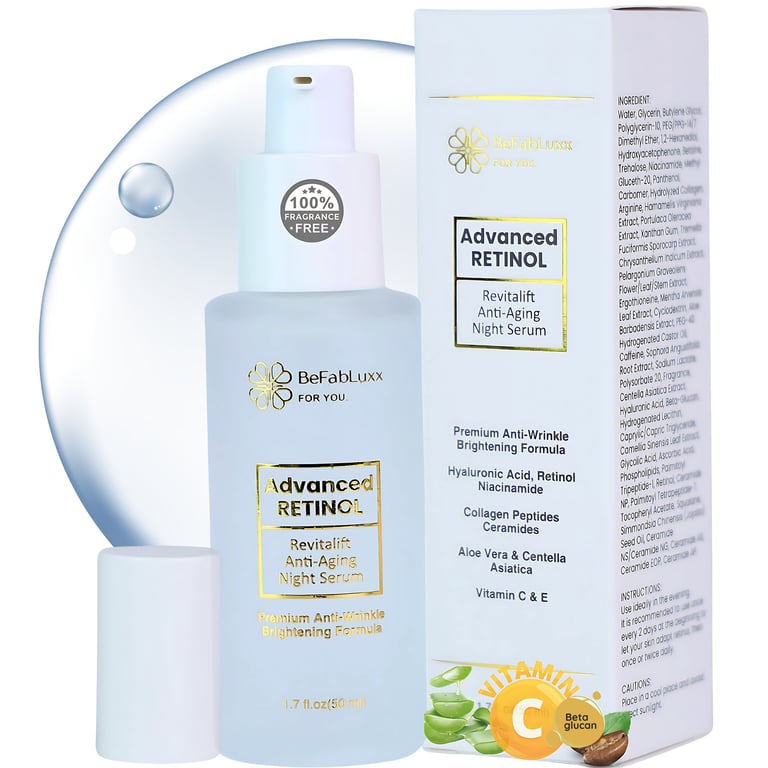
This distinction is important. The three moisturizers can be recommendations for a barrier-focused routine, while BeFabLuxx is the next-stage nighttime active for someone whose skin is comfortable and ready for retinol.
That makes your article feel like you're saying “Here are products I genuinely like”,